


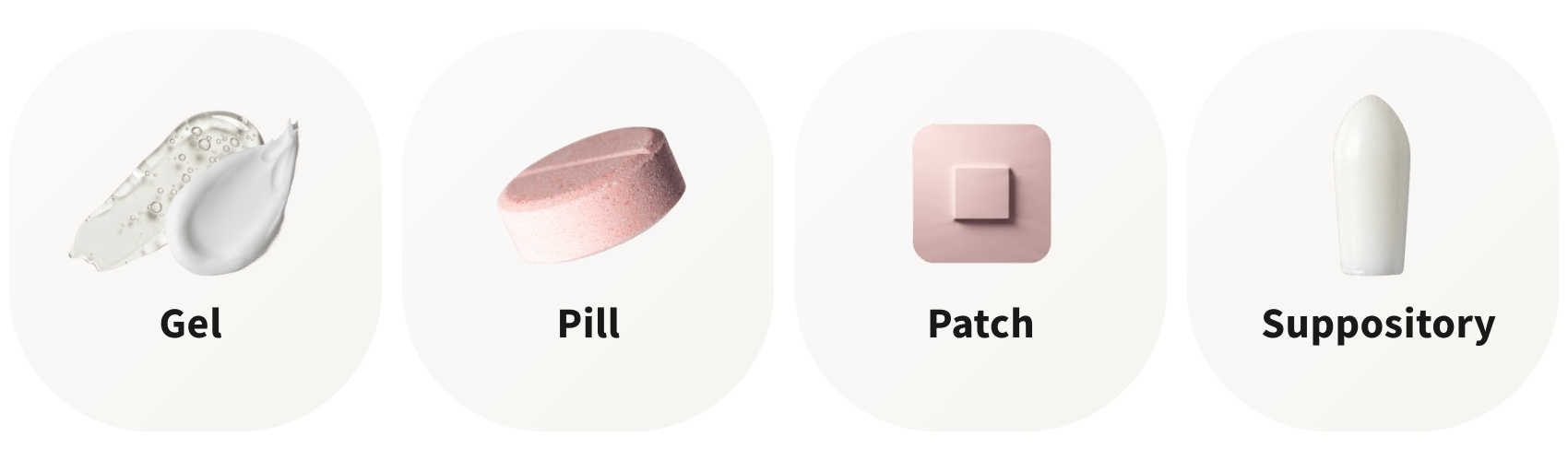








Oestrogen: Body-identical oestrogen available as skin gels, skin patches, and oral tablets. Gels and patches are recommended over oral tablets for women at an increased risk of blood clots, including those with a higher BMI (British Menopause Society).
Progesterone and Progestogens: Micronised progesterone (body-identical) or progestin tablets to protect the womb lining in women who still have a uterus.
Combined Hormonal Options: Instead of taking separate oestrogen and progesterone medications, combination options let you take both in a single daily pill. There are combined oestrogen+progestin tablets, and Tibolone which breaks down in the body to mimic oestrogen, progesterone, and a small amount of testosterone.
Vaginal Oestrogen: Creams or small vaginal tablets applied directly to relieve targeted symptoms like dryness, discomfort during sex, or recurrent UTIs. Vaginal creams are available as body-identical estradiol, estriol, or conjugated oestrogen.
Non-Hormonal Options: Fezolinetant is a non-hormonal treatment that targets the brain's temperature-regulating center to ease hot flushes and night sweats.
Testosterone: Testosterone gel may be prescribed off-label, only where clinically appropriate.
What about compounded bioidentical hormones?
We don't prescribe compounded bioidentical hormone therapy for systemic menopause treatment, because these preparations are not regulated in the same way as licensed medicines (KKH Menopause Guidelines). If you are currently using compounded hormones, you can drop us a message here and we will guide you on possible ways to proceed.
Both, whether you're starting MHT for the first time or continuing treatment you began elsewhere.
New Starts: We evaluate your full medical history, review symptoms, and initiate MHT where clinically appropriate.
Refills: We accept refill requests even if your MHT was originally started by another doctor. Just let us know what medication and dosage you’re currently on.
Not sure yet?
If you’re still exploring your symptoms or would like a broader discussion on treatment options before deciding on MHT, an exploratory menopause consultation (click here to book) may be a better place to start.
For most women, no bloodwork is needed to start or continue MHT (American College of Obstetricians & Gynecologists). We do ask for a mammogram from within the past year.
If you already have one, we’ll review it together. If not, we can help arrange the mammogram and any breast exams needed to get you started.
No, most patients only require one consultation per year. In between, refills can be requested online at no cost. Each refill can be up to a 6-month supply.
You’ll need to book a consultation if you’d like to adjust your dose or change your medications.
Yes, for healthy women under 60, or within 10 years of menopause onset. For this group of women, MHT is considered safe and effective for easing symptoms and preventing bone loss (Australasian Menopause Society).
For women over 60 or more than 10 years past menopause, local vaginal MHT remains a safe and viable option. Because vaginal MHT acts locally with minimal systemic absorption into the bloodstream, it carries a lower risk and is highly effective for vaginal dryness, recurrent UTIs, and discomfort during sex.
A family history of breast cancer does not automatically rule out MHT. We will consider your individual breast cancer risk, including who in your family was affected and at what age, alongside your own medical history and the type of MHT being considered (British Menopause Society).
A personal history of breast cancer is different: systemic MHT is generally not advisable, though local vaginal oestrogen may be evaluated in collaboration with your oncology team.
Many women notice improvement within 3-5 weeks, though some symptoms take longer to settle. We’ll review your response and adjust if needed.
Common early side effects include temporary breast tenderness, mild nausea and bloating, and these usually resolve in a few weeks. Persistent side effects can be managed by adjusting the dose and medication type with your doctor.
Not necessarily. MHT suits most women with troublesome symptoms, but there are situations where it needs to be delayed or avoided.
If MHT isn’t suitable for you, rest assured we’ll talk through alternatives and decide on next steps together.
Yes. You can start MHT during perimenopause while your periods are still regular. Clinical evidence shows that perimenopausal symptoms, such as sleep disruption, brain fog, joint pain, mood shifts, and hot flushes, can set in even before periods become irregular or stop completely (International Menopause Society
).
When you are still getting your periods, MHT is usually prescribed as a sequential or cyclical regimen, following your natural period cycles.
No. You don't need to 'try and fail' supplements or lifestyle changes before starting MHT. International guidelines recommend MHT as a primary, first-line treatment for bothersome vasomotor symptoms. While strength training, nutrition, and sleep hygiene are vital for long-term health, they are complementary tools, not mandatory prerequisites. If symptoms are impacting your quality of life today, MHT may be an option now.
MHT can make it easier to manage your weight during menopause by improving symptoms that affect how you eat, sleep and move. It is highly effective for symptoms such as hot flushes, poor sleep and joint pain. When these symptoms improve, you may find it easier to stay active, regulate your appetite and maintain healthy eating habits.
MHT is not a weight-loss treatment, but it may also help limit the shift towards abdominal fat that occurs as oestrogen levels fall. As oestrogen declines, the body tends to store more fat around the abdomen rather than the hips and thighs. MHT may help limit these changes in body composition over time, although it is not prescribed for weight loss alone (International Menopause Society).
If weight is your main concern, our Midlife Weight Management Screening provides a metabolic health assessment, with options to combine this with dietitian support and doctor-led treatments such as GLP-1 medications where appropriate.

.png)

